
On December 25, 26, 27, 2021, and January 1, 2, 3, 2022, museums will be closed.

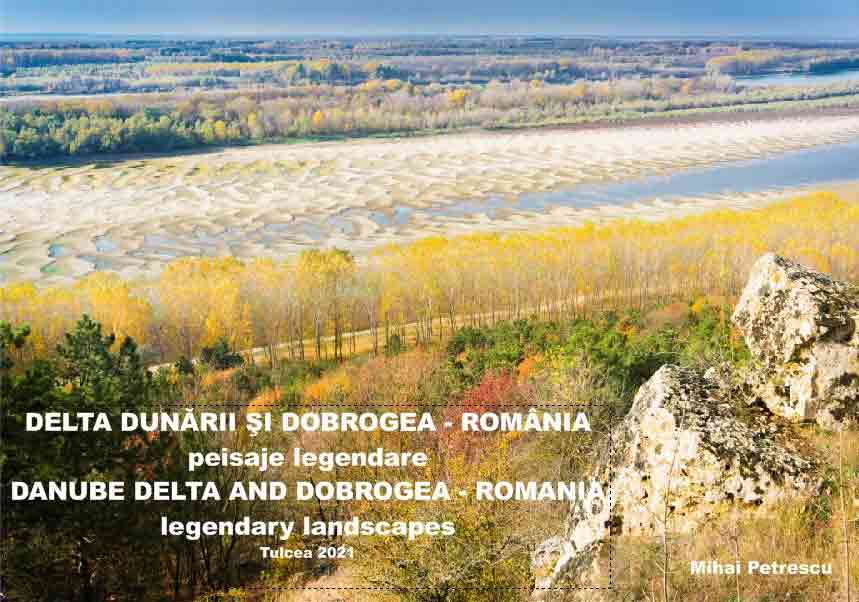
Here is the author’s presentation:
”Danube Delta and Dobrogea have remained a timeless land, even under the roller of modernism. It is rare to see a more lively place, with a hidden charm, which delights the eye but especially the soul. Here any extraordinary natural formation, the mountains, the Danube, the Black Sea, the various tribes of Dobrogea, all have a story, a legend that enhances their beauty and mystery. In order to enjoy the whole charm of these legends, however, I recommend reading them in original, especially the synthesis works, (C. Cealera, E.D. Gemală, A. Mitru etc.). Some of the stories are unedited, being told to me by the locals, as an ancestral heritage.
No matter how incredible they may be, they deserve to be recorded, being the last snippets that the locals remember, from the treasure trove of stories inspired by Dobrogea, or brought from their homelands, along with relics or icons. Just as legends have a kernel of truth, also scientific truths acquire in Dobrogea the fabulous note of legends. The stories of Dobrogea recount about the vanished secular forests, now replaced by steppes, about islands and cities sunk in the incessant change of the course of the Danube or of the sea shores, about an underground network of rivers, natural caves, or tunnels dug for strategic purposes, many of which have not been identified so far.
The wonderful landscapes of former Dobrogea are today largely preserved in protected areas of European importance (Natura 2000). They represent true oases of natural beauty in an environment that becomes more and more artificial due to human activities. Besides the conservation of flora, fauna, geological environment, these protected areas have a cultural importance, through the associated legends, ethnicities or archaeological vestiges, with which I tried to complete the charm of these reserves in the present book. I wrote this book primarily for the public to fall in love with the land of Dobrogea and the Danube Delta, in the hope that this way this region will be better protected.”
The album “DANUBE DELTA AND DOBROGEA – ROMANIA, legendary landscapes”, Second Edition, revised and added, author: Mihai Petrescu; Tulcea 2021 – ISBN 978-973-0-34235-2), 160 pages, price 150 lei, can be purchased directly at the TULCEA AQUARIUM shop, (DANUBE DELTA ECOTURISTIC MUSEUM CENTER, 14 November No.1, tel. 0340105652) or by courier (telephone order: 0040513231 (ICEM secretariat), 0340105652 (Tulcea Aquarium), or by e-mail: icemtl@icemtl.ro, petrescumihai1234@gmail.com).


NOVEMBER 2021. Avramide House from 32 Progresului Street, invites visitors to contemplate the work “Peasant” (glazed ceramic plate), belonging to the collection of European decorative art, a work whose creator is Eugen Ispir (b. 1909, Văratec, Neamț – d. 1974, Bucharest).
”Eugen Ispir fulfills, in front of his art, the essential aesthetic conditions; he is going through a rigorous, personal temperament, with rich and charming resources; you are thus put in the situation to analyze, to think and to feel – especially – everything that the artist wanted to confess in the abstract language of forms.
Ispir’s art, consistent and solid, brings a new breath, of personal vigor, of mental health and especially of original plastic vision. ”
Lucia Saghin, “Convorbiri literare”

NOVEMBER 2021. The Art Museum from Grigore Antipa Street, no. 2, invites visitors to contemplate the work “Landscape with a red house” – oil / cardboard, belonging to the collection of paintings, creator – Theodor Pallady (b. April 11, 1871, Iasi – d. August 16, 1956, Bucharest).
“Theodor Pallady had a noble ancestry, was born in 1871, was raised and educated in an old family of boyars in Moldova. This is how he manifested all his life, like an aristocrat, taking refuge in art, which he considers a necessity, and by no means a skill.
Pallady studied engineering at the Dresden Polytechnic until 1889, while taking drawing and painting lessons with Erwin Oehme, who, recognizing his artistic endowment, advised him to go to Paris. In the French capital, he worked in Jean Arman’s studio and enrolled at the Académie des Beaux-Arts.
In 1904 he returned to the country and exhibited at the Romanian Athenaeum and at the Official Salons. However, he kept in touch with Paris, where he opened several personal exhibitions. The close friendship with the French painter Henri Matisse, with whom he frequently corresponded, was beneficial to both sides, in the sense of an intense exchange of constructive opinions.
This is when Theodor Pallady finds his own way. Moment when his works become the target of art critics.
The symbolism initially perceived from the perspective of his teacher, Gustave Moreau, is the substratum of many of his works. Hence his passion for painting nudes and static nature.
Art critics have noticed that in Theodor Pallady the line is the tool of an architect who builds, and the surface and volume of the shapes are often determined with the help of angular lines. We find in Pallady a rivalry between color and drawing.
“In his painting, the relationship between color and drawing is in a permanent relationship with matter-spirit and you do not know where one ends and the other begins, because reason prevails. The topics approached are static nature, landscape, nude, portrait, but in the maturity part it approaches especially static nature and compositional nude. ” IOAN ŞULEA, director of the Art Gallery of the Mureş County Museum
His nudity seems to be in a permanent interweaving with the atmosphere of the interiors. The woman appears as a symbol of love, and less of desire, as a meditation on destiny. In works with still life, objects lose their reality, gaining subtle meanings. Its harmonies aim at the viewer’s ability to realize in imagination the secret life of colors and shapes. If in other artists the objects are used in a purely decorative sense, devoid of the load of deep meaning, in Pallady they have a spiritual beauty. Pallady said that “drawing can be independent, while color without drawing remains something invertebrate.”
Melik House, located in Bucharest, which was built in 1750-1760, today houses the Theodor Pallady Museum. Here are exhibited paintings painted on canvas by Pallady as well as over 800 drawings with landscapes, nudes, portraits or interiors, representative of the Parisian period of the painter.
In 1956, the year in which he died, he received the title of Emeritus Master of Art, organizing the retrospective exhibition “Theodor Pallady”. In 2012 he was declared a post mortem member of the Romanian Academy.
Theodor Pallady undoubtedly remains one of the most prestigious modern artists, retaining his full ambition to be a painter “of all times.”
Source: https://www.radioromaniacultural.ro/theodor-pallady-pictorul-care-controla-culoarea-prin-spirit-si-ratiune/
Mai multe despre November

Between September 2021 and March 2022, at the “Danube Delta” Eco-Tourism Museum Center “Danube Delta” – 1, 14 Noiembrie Street, the public can watch the exhibition “Invasive species from Romania of interest to the EU”.
Organizer: “Gavrilă Simion” Eco-Museum Research Institute – Tulcea, in collaboration with the University of Bucharest and the Ministry of Environment, Waters and Forests.
What the organizers say:
“The exhibition brings to the public’s attention the issue of invasive or potentially invasive plant and animal species, reported in the country, which is also a problem at European level. The infographic materials, which present information on the origin of invasive species, routes of entry into national flora and fauna, invaded habitats and their impact on biodiversity, human health and economy, were developed within the project Adequate Management of Invasive Species in Romania, according with EU Regulation 1143/2014 on the prevention and management of the introduction and spread of invasive alien species, co-financed by the European Regional Development Fund through POIM 2014-2020. “

”His contemporary and great poet Tudor Arghezi describes him in two words as appropriate as “lazy and brilliant”, and the painter Nicolae Tonitza, his colleague from the “Group of Four”, considers him the most daring, most expressive and at the same time, deeper in thought, among all our contemporary sculptors “,” our only sculptor of great and high vision “.” (Doina Păuleanu)
”Creator of portraits, figurative compositions, female nudes, monuments, Han gives his characters, without exception, through their athletic body, a monumental solemnity, an intrinsic heroism.” (Corina Teacă)

